Radiometric Dating
Spontaneous breakdown or decay of atomic nuclei, termed radioactive decay, is the basis for all radiometric dating methods. Radioactivity was discovered in 1896 by French physicist Henri Becquerel. By 1907 study of the decay products of uranium (lead and intermediate radioactive elements that decay to lead) demonstrated to B. B. Boltwood that the lead/uranium ratio in uranium minerals increased with geologic age and might provide a geological dating tool.
Just for review, an element is defined as all the atoms which have a specific number of protons in their nucleus. However, different atoms of the same element may have different numbers of neutrons in their nucleus. Atoms of the same element, but with different numbers of neutrons are said to be different isotopes of that element. They are chemically the same, but have different atomic masses. The average atomic mass of an element depends on the relative proportions of each isotope. Unfortunately, these proportions are not the same from place to place and they can change over time as well. Thus, a periodic table for the lower mantle or for the surface of Mars would have different average atomic masses from the periodic table that we use for materials at the earth's surface. We would probably find that the average atomic masses for some elements would have been slightly different in the geological past as well.
Nuclear Stability
|
Radioactive atoms are atoms for which the nucleus is unstable. All atomic nuclei were either produced as part of the Big Bang or in the cores of stars through the process of nuclear fusion. Atoms with atomic numbers greater than 26 (Iron) are produced during super novae - explosions of massive stars. Nuclei can be modified in a wide variety of situation such as in collisions with fast-moving subatomic particles that are part of solar radiation. A wide variety of atoms were made and are being made in these situations. Very few of the all the possible different types of nucleus (nuclides) are stable enough not to fall apart immediately.
A small number of nuclides are stable and will persist more-or-less indefinitely. Others are unstable, some so much so that most decay within seconds, others are stable enough that most atoms of that isotope still are present after millions of years.
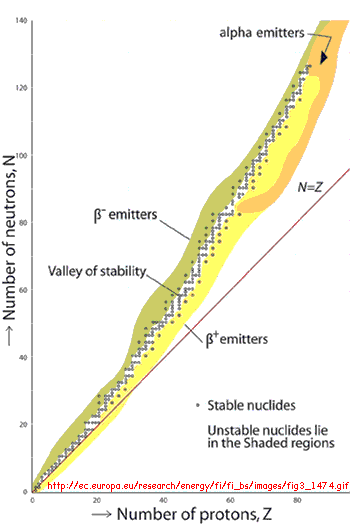
What causes a nucleus to be unstable? Among other things, the stability of an atomic nucleus depends on its ratio of protons and neutrons. Unstable nuclei decompose either by splitting into several smaller nuclei or by ejecting particles (protons, electrons, neutrons, anti-electrons (also called positrons), alpha particles etc.), and converting neutrons to protons or protons to neutrons. The original nucleus (the Parent nucleus) can produce one or somethimes two new nuclei (Daughter nuclei) which is a different element than the parent.
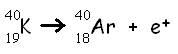
One example is the decay of Potassium 40 (19 protons, 21 neutrons) into Argon 40 (18 protons, 22 neutrons) In this process a proton transforms into a neutron by the emission of a positron (anti electron, like an electron but with a positive charge).
 |
 |
Some radioactive atoms are produced continuously as the result of collisions between stable atoms and high-speed subatomic particles (protons, neutrons, etc.) that are components of solar radiation. These collisions alter the balance of protons and neutrons in the nucleus and, perhaps, make the nucleus unstable. An example of this is the creation of Carbon-14 (6 protons, 8 neutrons) which is converted from Nitrogen-14 (7 protons, 7 neutrons) by solar radiation. One of two things occur to make this transformation:
- a neutron collides with the N-14 nucleus and dislodges a proton while the neutron remains in the nucleus
- an electron collides with the N-14 nucleus and combines with a proton to form a neutron.
The Radioactive Decay Process
|
These decay processes have the same characteristics as the first order chemical decomposition reactions that you learn in grade 12 chemistry. As radioactive "parent" (P) atoms decay to more stable "daughter" (D) atoms (such as Uranium decaying to Lead), each disintegration results in one more atom of the daughter than was initially present and one less atom of the parent. Each nucleus has a certain probablility of decaying at any given moment. Thus, the rate of the reaction (R) is proportional to the number of nuclei present in a sample (A).
Just as in grade 12 chemistry, if we can calculate a constant of proportionality (k) we can calculate the rate (R) of the decomposition for the nuclear decay reaction P ---> D as:
R=kP where P = the amount of Parent material (technically moles or molar concentration)
Unlike chemical decomposition reactions, the probability of any particular parent atom decaying in a fixed period of time is always the same for all atoms of that type regardless of temperature, pressure, or chemical conditions. This is because subatomic particles exist in discrete energy states (remember Bohr?) and the energies involved in nuclear reactions are so large that they are not influenced by the comparatively low energy conditions outside the nucleus. Thus, the rate constant (the probability of decay) always is the same, and so we can know what the decay rate would have been in the geological past - the same as it is now.
As you learned in grade 12 chemistry, the first-order rate equation (R=kA) can be integrated to make the equation:
ln(Po/Pt) = kt.
Po = initial # of parent atoms,
Pt = # of parent atoms after time "t"
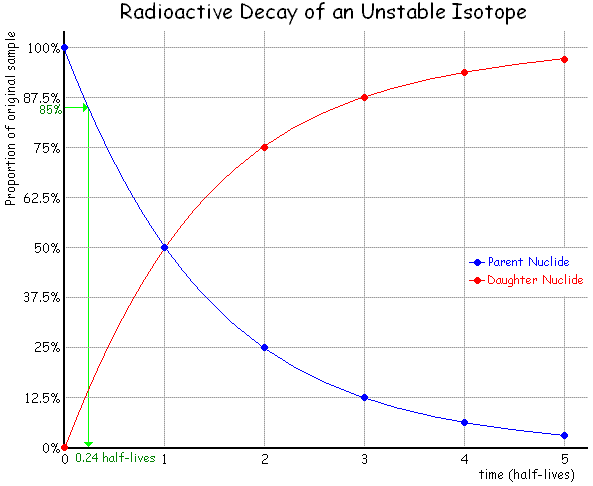
One of the consequences of this equations is that the time it takes to reduce the amount of radioactive nuclei by one half is a constant which we call the half-life (t0.5). Each span of time equal to a the half-life sees the amount of radioactive nuclei decrease by 50%. The number of daughter nuclei increases by the same amount at the same time.
As we might have learned in grade 12 chemistry, when t = t0.5, Po/Pt = 2
Therefore, we can write ln(2) = kt0.5
This is handy in grade 12, but we can just rely of our physicist friends to determine the half-lives of different isotopes as those that are tabulated below. We can generate our own equation to calculate Pt based on the fact that after each half life, the amount of Parent material is reduced by half:
Pn = Po(0.5)n wher n = number of half-lives (n = t / t0.5)
For example, after 2 half lives, the proportion of Parent material remaining should be (0.5)2 = 0.25
Or, 25% of the Parent remains and 75% of the Parent atoms will have been converted to Daughter product. This equation works for fractions of a half-life as well.
Po may not be a quantity that we can determine independently. However,
IF:
i) there is no daughter product to begin with in the mineral.
(especially the case in K/Ar dating where the daughter is a noble gas)
ii) No daughter product leaks into or out of the mineral crystal (depends on the mineral)
iii) No parent atoms leak into or out of the mineral crystal (depends on the mineral)
THEN:
Po = Pt + Dt (we can measure Pt and Dt using a mass spectrometer)
We also can develop an equation using Dt/Pt.
From the graph, we can see that when...
t = 0, Dt/Pt = 0 / 1 = 0
t = 1t0.5, Dt/Pt = 0.5/0.5 = 1
t = 2t0.5, Dt/Pt = 0.75/.25 = 3
t = 3t0.5, Dt/Pt = 0.875/.125 = 7
t = 4t0.5, Dt/Pt = 0.9375 /0.0625 = 15
As each half life passes, half of the remaining P is turned into D.
The sequence 0, 1, 3, 7, 15 is (2n-1) where n is the number of half lives.
So, if Dt/Pt = 2n-1
Then ln((Dt/Pt) + 1) = ln(2) x n
ln((Dt/Pt) + 1) / ln(2) = n
|
 |
Most elements on earth have at least one isotope which is unstable, some having half-lives in the millions or billions of years. Most were incorporated into the earth when the solar system formed. These atoms get incorporated into rocks, minerals, plants, and animals along with the non-radioactive isotopes of the same elements. Thus, the earth, its hydroshpere and its atmosphere are full of radioactive atoms (just as we are). When a mineral forms from the cooling of lava or when dissolved ions precipitate out of solution, the proportion of radioactive isotopes within the mineral crystal is the same as in the lava or solution. Most of the time, the daughter atoms of these radioactive isotopes will not be present in the original cyrstal because they do not form part of the chemical structure of that mineral. For example, minerals containing potassium ions will not also contain Argon atoms, because Argon is an inert Noble Gas and will not form part of an ionic crystal lattice. This means that we know that the mineral crystal started out with no daughter atoms present. However, once the mineral crystal is formed, the daughter atoms that form by radioactive decay may not be able to get out of the crystal - as is the case for many minerals in which daughter Argon atoms form. Thus, appearance of daughter nuclei and the loss of parent nuclei constitute a clock that allows geologists to determine the age of the rocks in which they occur.
The radioactive parent elements that commonly used used to date rocks and minerals are:
| Parent | Daughter | Half-life |
| Uranium-235 |
Lead-207 |
0.704 billion years |
| Uranium-238 |
Lead-206 |
4.47 billion years |
| Potassium-40 |
Argon-40 |
1.25 billion years |
| Rubidium-87 |
Strontium-87 |
48.8 billion years |
| Samarium-147 |
Neodymium-143 |
106 billion years |
| Thorium-232 |
Lead-208 |
14.0 billion years |
| Rhenium-187 |
Osmium-187 |
43.0 billion years |
| Lutetium-176 |
Hafnium-176 |
35.9 billion years |
| Carbon-14 |
Nitrogen-14 |
5568 years |
Credit: U.S. Geological Survey Department of the Interior/USGS
The useful dating range for any radioactive isotope is from less than 1% of a half-life to about 6 half-lives. Outside of that range either the amount of daughter atoms or parent atoms is too small to measure accurately.
What Can We Date
 Radiometric dating using the naturally-occurring radioactive elements is simple in concept although technically complex in practice. If we know the number of radioactive parent atoms present when a rock formed and the number present now, we can calculate the age of the rock using the decay constant. The number of parent atoms originally present is simply the number present now plus the number of daughter atoms formed by the decay, both of which are quantities that can be measured. Samples for dating are selected carefully to avoid those that are altered, contaminated, or disturbed by later heating or chemical events. These events can allow daughter atoms to escape the mineral crystals. Radiometric dating using the naturally-occurring radioactive elements is simple in concept although technically complex in practice. If we know the number of radioactive parent atoms present when a rock formed and the number present now, we can calculate the age of the rock using the decay constant. The number of parent atoms originally present is simply the number present now plus the number of daughter atoms formed by the decay, both of which are quantities that can be measured. Samples for dating are selected carefully to avoid those that are altered, contaminated, or disturbed by later heating or chemical events. These events can allow daughter atoms to escape the mineral crystals.
In addition to the ages of Earth, Moon, and meteorites, radiometric dating has been used to determine ages of fossils, including early man, timing of glaciations, ages of mineral deposits, recurrence rates of earthquakes and volcanic eruptions, the history of reversals of Earth's magnetic field, and the age and duration of a wide variety of other geological events and processes.
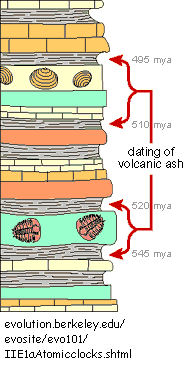
In order to date anything, we must have crystals that have formed from lava or dissolved directly from a solution. For most sedimentary rocks, especially those containing fossils, this rarely is the case. These materials cannot be dated directly. However, dates still can be obtained if there are volcanic deposits above and below the sedimentary rock layers in question. If such layers can be found to "bracket" a sedimentary rock layer, that sedimentary rock layer must be younger than the lower volcanic layer and older than the upper layer. Thus, in the sedimentary sequence to the right, the trilobite fossils in the sedimentary rock layer coloured green must be between 545 million years old (mya) and 520 mya in age. The bivalve fossils in the layer coloured yellow must be between 510 and 495 mya in age. If we know the rate at which sediments are deposited (how many thousand years per millimetre), we can estimate an even more precise age.
|
The following is a group of rocks and materials that have dated by various atomic clock methods:
| Sample | Approximate Age in Years |
- Cloth wrappings from a mummified bull
- Samples taken from a pyramid in Dashur , Egypt . This date agrees with the age of the pyramid as estimated from historical records
|
2,050
|
- Charcoal
- Sample, recovered from bed of ash near Crater Lake , Oregon , is from a tree burned in the violent eruption of Mount Mazama which created Crater Lake . This eruption blanketed several States with ash, providing geologists with an excellent time zone.
|
6,640
|
- Charcoal
- Sample collected from the "Marmes Man" site in southeastern Washington . This rock shelter is believed to be among the oldest known inhabited sites in North America
|
10,130
|
- Spruce wood
- Sample from the Two Creeks forest bed near Milwaukee , Wisconsin , dates one of the last advances of the continental ice sheet into the United States .
|
11,640
|
- Bishop Tuff
- Samples collected from volcanic ash and pumice that overlie glacial debris in Owens Valley , California . This volcanic episode provides an important reference datum in the glacial history of North America .
|
700,000
|
- Volcanic ash
- Samples collected from strata in Olduvai Gorge, East Africa , which sandwich the fossil remains of Zinjanthropus and Homo habilis - possible precursors of modern man.
|
1,750,000
|
- Monzonite
- Samples of copper-bearing rock from vast open-pit mine at Bingham Canyon . Utah .
|
37,500,000
|
- Quartz monzonite
- Samples collected from Half Dome, Yosemite National Park , California .
|
80,000,000
|
- Conway Granite
- Samples collected from Redstone Quarry in the White Mountains of New Hampshire.
|
180,000,000
|
- Rhyolite
- Samples collected from Mount Rogers , the highest point in Virginia .
|
820,000,000
|
- Pikes Peak Granite
- Samples collected on top of Pikes Peak , Colorado .
|
1,030,000,000
|
- Gneiss
- Samples from outcrops in the Karelian area of eastern Finland are believed to represent the oldest rocks in the Baltic region.
|
2,700,000,000
|
- The Old Granite
- Samples from outcrops in the Transvaal, South Africa . These rocks intrude even older rocks that have not been dated.
|
3,200,000,000
|
- Morton Gneiss [see Editor's Note ]
- Samples from outcrops in southwestern Minnesota are believed to represent some of the oldest rocks in North America.
|
3,600,000,000
|
Practical Issues
Nothing in nature is simple in practice and radiometric dating is no exception. In order for everything to be simple, the following must be true:
- the decay constant must be constant (this much is the case)
- there should be no atoms of the daughter element in the mineral crystal when it is formed (often not the case).
- the daughter atoms must not be able to escape the crystal once formed (often not the case, but we can determine which are minerals are leaky by experiment and avoid those minerals for dating purposes)
- no parent atoms should be able to get into or out of the mineral crystal once it has formed (no metamorphosis or chemical alternation (weathering) of the mineral must have taken place).
- the proportion of isotopes of the parent element also should be known
Example: K-Ar dating
Potassium-Argon dating is a good example of a system that often satisfies all of these conditions:
- many minerals include Potassium as part of the mineral chemistry.
- Argon rarely forms part of the original mineral as it is an inert gas.
- many minerals are closed to both Potassium and Argon
(neither can get into or out of the mineral crystal once it is formed).
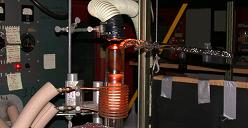
Imagine that we obtain a crystal of biotite mica from a volcanic ash layer. You might not think that a flaky mineral like mica would be closed to Argon gas, but it is. You analyse the crystal and find that it contains 0.0017 moles of K-40 (Potassium-40) per gram and 0.0003 moles of Ar-40 per gram. We can determine that the original content of K-40 must have been 0.002 moles per gram (0.0017 + 0.0003), since the only way that Ar-40 could be in the crystal is through the decay of K-40. Thus, the percentage of original K-40 that is still present is:
100% x 0.0017 mol/g / 0.002 mol/g = 85%
Reading from 85% on the y-axis of the half-life graph above to the parent nuclide line and down to the X-axis we see that 85% decay corresponds to 0.24 half-lives. From the chart above, we know that the half-life of K-40 is 1.25 billion years. Therefore, the age of the biotite crystal in this ash deposite (and, therefore, the age of the ash deposit itself) is:
1.25 bya x 0.24 = 0.30 bya (300 million years old, plus or minus 5 million years).
|
 |
The actual precision in the K-40 half life and the actual precision in measuring the isotope quantities result in a relative error of about 2%. Technology has reached the point where a geochronologist could make a pretty good determination of your age from a small chip from one of your teeth. However, the same percent error in a mineral hundreds of million years old would still produce an error of millions of years. In very old sedimentary rocks, relative dating using fossils may yield greater precision.
Example: C-14 Dating
Carbon-14 dating is an example of a situation in which one of the criteria is not satisfied: organic matter (which is what Carbon-14 methods date) is full of the daughter element (Nitrogen). So, we cannot use the amount of daughter isotope to determine the original amount of parent.
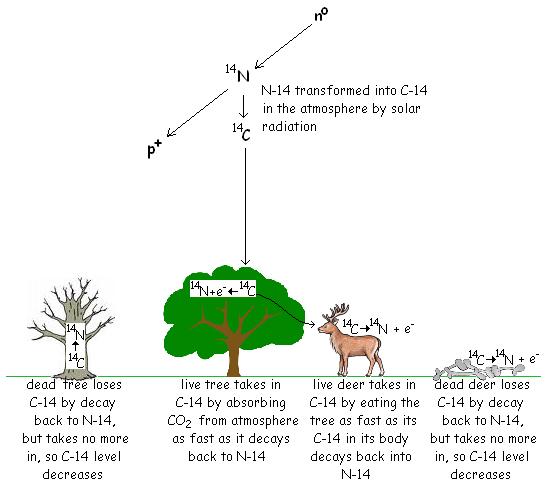
However, C-14 is produced in the atmosphere by solar radiation. The rate of C-14 decay increases as the amount of C-14 increases (remember that rate = k times amount. The levels of solar radiation seem to be relatively constant (our sun is a pretty stable class of star). Therefore, the atmosphere should be in a state of equilibrium in which the rate at which C-14 is decaying N-14 is equal to the rate at which C-14 is being created by solar radiation in the upper atmosphere.
Thus, the C-14 levels in the atmosphere now should be the roughly the same as they were in the past. C-14 is incoroporated into CO2 and absorbed by plants. Plants are eaten by animals so that they too take in C-14. Both plants and animals take in C-14 but also lose it as C-14 decays back into N-14. As long as the organisms are alive and taking in food, C-14 uptake and loss will be in equilibrium, and the C-14 levels should be the same as in the atmosphere. When the organism dies, C-14 continues to decay back into N-14, but the C-14 is not replaced by food intake. At that point, the C-14 levels will decrease following the same radioactive decay curve as displayed above. In this way, C-14 dating establishes the time elapsed since the organism died.
|
 |
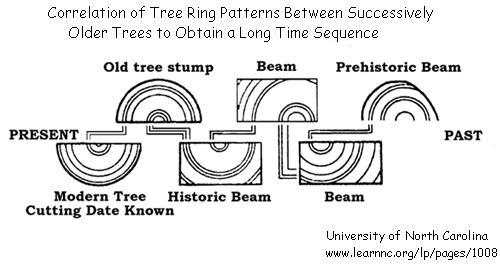
What about changes in solar radiation that may have changed the C-14 levels in the past. Geologists use tree ring dating to calibrate the C-14 dating curve. By correlating tree rings between successively older trees and both counting rings back from the present and dating each ring by C-14 dating, an accurate correspondance between years since death and C-14 levels. This works because wood is not living tissue so the C-14 in wood is not replaced even while the tree is alive.
Imagine that you have collected charcol from under a lava flow in which the mineral crystals are too small to date. You might reasonably assume that the tree was killed by the lava flow. If you found that the C-14 content of the charcol is 12.5% of what would be expected in a living tree, the radioactive decay curve tells us that 3 half-lives have elapsed since the death of the tree. The half life of C-14 is 5568 years. From this data we can conclude that the lava flow is 16700 years old (5568 x 3 = 16700).
|
 |
Example: Isochron Dating, Rb-Sr dating
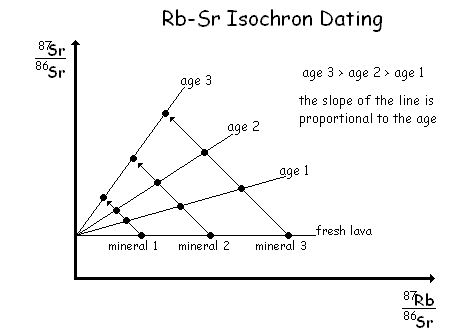 What else can be done to deal with the issue of daughter element contamination? One method is to produce an isochron graph. Consider a volcanic deposit with minerals containing Rubidium and Strontium. Rb-87 decays into Sr-87 with a predictable half-life. However, the minerals also contain stable Sr-87 and Sr-86 when they are formed. This system is not as simple to manage as K-Ar dating. However, If we extract a number of different minerals from the deposit with different amounts of Rb-87, depending on their chemical formulas.
The trick to this method is to divide both the amounts of Sr-87 and Rb-87 in each mineral by the amounts of Sr-86. The isochron graph is a plot of the Sr-87/Sr-86 ratio versus the Rb-87/Sr-86 ratio. Each mineral should start with the same Sr-87/Sr-86 ratio since both isotopes are chemically identical. Each mineral will have a different Rb-87/Sr-86 ratio. Thus, the plot of the two ratios in each mineral will initially form a straight, horizontal line.
As Rb-87 decays to Sr-87, the Sr-87/Sr-86 ratio will increase and the Rb-87/Sr-86 ratio will decrease. However, the more Rb-87 that is present in each mineral, the faster these ratios will change. The points for the minerals with more Rb-87 will rise up to the left faster. The result is that the plot of points will form a line with a steeper and steeper line the older the volcanic deposit gets. Since the process is mathematically predictable, the slope of such a plot for any given deposit will allow the age of the deposite to be calculated.
There are many other radiometric dating methods. One method - fission track dating - involves counting the damage tracks formed in mineral crystals from the high-speed particles given off by some forms of readioactive decay. All of these methods involve counting the results of some radioactive process.